
Just 4 companies now control 75% of the US market for negotiating prescription drug rebates, up from 70% in 2022. That is the headline finding from the American Medical Association's September 2026 analysis of competition among pharmacy benefit managers (PBMs).
If you have never heard of a PBM, you are in good company. Yet these companies help decide which medications your insurance covers, which pharmacy you can use, and how much you pay at the counter. They sit between you and nearly every prescription you fill.
That 75% figure deserves some context. It is based on people enrolled in commercial and Medicare drug plans and excludes employers that contract directly with PBMs. The AMA notes that an industry estimate based on prescription claims puts the largest PBMs even higher, so if anything, 75% is conservative.
In this post, I will walk through what PBMs are, how they make money, and who owns them. Then I will explain why their consolidation matters to anyone who believes the free market should bring down drug prices. Finally, I will make my case: the United States has given the market a long and fair trial, and our peer countries are showing us a better way.
What is a pharmacy benefit manager?
A pharmacy benefit manager is a middleman who runs the prescription drug side of your health insurance. PBMs were created in the 1960s to help insurers contain drug spending, and today they manage drug benefits for the vast majority of Americans.
When your insurer or employer hires a PBM, it is buying a bundle of services. The AMA analysis tracks 5 of them:
Rebate negotiation. The PBM negotiates discounts, paid as rebates, with drug manufacturers.
Formulary management. The PBM helps decide which drugs your plan covers and which tier they sit on.
Pharmacy network management. The PBM decides which pharmacies are in network and how much they are reimbursed.
Claims adjudication. The PBM processes every prescription claim at the pharmacy counter.
Benefit design. The PBM shapes copays, coinsurance, prior authorization, and step therapy rules.
In theory, this is a useful job. A PBM that covers millions of people can tell a drugmaker, "Give us a better price, or we will favor your competitor." That leverage can push prices down. The catch is that the savings only reach you if the PBM market is competitive and the money actually flows back to your plan.
How do PBMs make money?
PBMs earn revenue in several ways, and some of them create incentives that work against patients.
1. Manufacturer rebates. Drugmakers pay PBMs rebates in exchange for favorable placement on the formulary. Historically, PBMs kept a share of those rebates. Because rebates are usually calculated as a percentage of a drug's list price, a PBM can earn more from an expensive drug with a big rebate than from a cheaper drug with a small one. Patients whose coinsurance is based on list price can end up paying more, even when the plan receives a discount.
2. Administrative and service fees. PBMs charge plan sponsors fees for processing claims and managing the benefit. Some fees paid by manufacturers are also tied to list price, which rewards higher prices.
3. Spread pricing. A PBM can charge your plan one price for a prescription and reimburse the pharmacy a lower price, keeping the difference. The Federal Trade Commission estimated that the 3 largest PBMs earned about $1.4 billion in spread pricing income on specialty generic drugs alone between 2017 and 2022.
4. Their own pharmacies. The largest PBMs own mail-order and specialty pharmacies, and they can steer patients toward them. In its January 2025 report, the FTC found that the Big 3 PBMs marked up dozens of specialty generic drugs, including cancer and HIV medications, by hundreds or thousands of percent at their affiliated pharmacies. Those markups generated more than $7.3 billion in revenue above the drugs' estimated acquisition costs from 2017 to 2022.
To be fair to the industry, specialty generics are a small slice of total drug spending, and the PBMs called the FTC's findings cherry-picked. But the pattern matters: when the same company sets the price, runs the pharmacy, and decides where you fill your prescription, the incentives are not lined up with yours.
Congress has started to respond. The Consolidated Appropriations Act, signed on February 3, 2026, requires PBMs to pass through 100% of manufacturer rebates to employer plans and Medicare drug plans. Starting in 2028, PBM pay in Medicare Part D must be a flat service fee rather than a cut of the drug's price. These are real steps, but they regulate how PBMs get paid. They do not address how few PBMs there are.
Who are the biggest PBMs, and who owns them?
The 7 largest PBMs manage rebate negotiation for 96% of the market in the AMA data, and every one of them is owned by, or jointly owned with, a health insurer. Here is the national picture for rebate negotiation in 2022 and 2024.
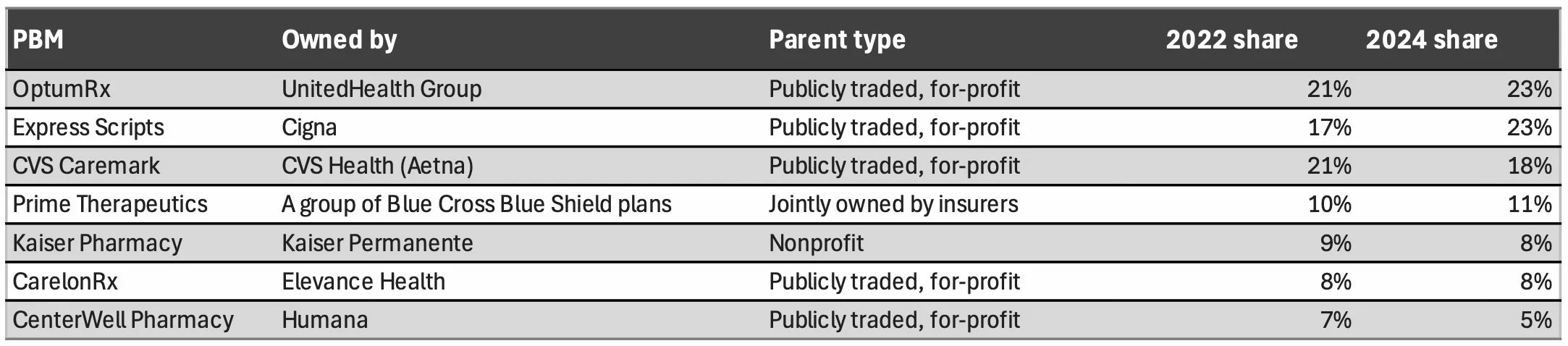
Source: AMA Policy Research Perspectives, September 2026, Exhibit 2 (AMA competition research hub). Shares are for combined commercial and Medicare Part D drug plan enrollees.
A few things jump out from this table.
The top 3 are part of the largest healthcare companies in the country. OptumRx, Express Scripts, and CVS Caremark are each owned by publicly traded parent companies that also sell health insurance and operate pharmacies. UnitedHealth Group is now the largest drug plan insurer and the largest PBM in the United States. It also employs almost 10,000 physicians, according to the AMA.
Customers move between giants, not away from them. Express Scripts jumped from 17% to 23% largely because Centene, a major insurer, switched its business from CVS Caremark. When one large contract moves, it simply shifts market share from one of the big 3 to another.
Vertical integration is the norm, not the exception. Nationally, 69% of people with drug coverage are insured by a company that either owns its PBM or runs those functions in-house. In Medicare Advantage drug plans, that figure is 77%. Economists call this vertical integration, meaning one company controls several links in the same supply chain.
Local markets are even tighter. Most people do not shop for a PBM nationally; their insurer picks one in their region. Across Medicare's 34 drug plan regions, 94% of PBM markets were highly concentrated in 2024, up from 82% in 2022.
Why antitrust matters if you trust the market
If you believe the free market is the best way to bring drug prices down, you should be the loudest voice in the room for antitrust enforcement. Markets lower prices through competition. Take away the competition, and what remains is not a free market. It is a toll booth.
Here is how the logic breaks down when a handful of firms control a market.
Concentration weakens the pressure to pass savings along. Economists measure concentration with the Herfindahl-Hirschman Index (HHI). Under federal merger guidelines, a market with an HHI above 1,800 is considered highly concentrated. The average regional PBM market scored 2,574 in 2024, up 164 points from 2022. The AMA is blunt about why this matters: PBM markets need to be competitive for rebates to be fully passed through. When there are only 3 or 4 realistic options, a PBM has less reason to share its savings with your plan, and your plan has fewer places to go if it does not.
Secret prices cannot discipline anyone. Competition works when buyers can compare prices. PBM rebate contracts are confidential, so employers, patients, and even many insurers cannot see what a drug really costs after discounts. A market with hidden prices and few sellers is exactly where you would expect prices to drift up.
Vertical integration lets giants raise their rivals' costs. When an insurer owns its PBM, that PBM can offer smaller rebates or worse terms to competing insurers. A 2026 study in the American Economic Journal: Applied Economics examined a large 2015 merger between an insurer and a PBM in Medicare's standalone drug plan market. After the merger, premiums rose for insurers that were not integrated with a PBM, and the researchers found no evidence that the merged company lowered its own premiums. The efficiency gains promised by integration did not show up for consumers.
Size in one market becomes a barrier in the next. A new competitor that wants to challenge UnitedHealth Group cannot just launch a PBM. It may also need an insurer, a pharmacy network, a data business, and physician practices to compete on equal terms. Economists call this multilevel entry, and it makes new competition far less likely.
None of this means that every large PBM behaves badly. It means that the conditions a free market needs to work (many sellers, transparent prices, and easy entry) are largely missing. State governments have started to act. Arkansas and Tennessee have banned PBMs from owning pharmacies, and Congress has reintroduced the Patients Before Monopolies Act, which would force PBMs to divest their pharmacies. Express Scripts and CVS Health are suing Tennessee over its law.
We tried the market. Here is what happened.
The United States did not stumble into this system by accident. We chose it, and we gave it a long run.
When Congress created Medicare Part D in 2003, it wrote in a provision known as the "noninterference clause." It barred Medicare from negotiating drug prices directly with manufacturers. Instead, the program relied on private drug plans and their PBMs to compete and bargain prices down. That was the market experiment, and it ran for nearly 2 decades.
So how did it go? Here are the results.
Americans pay far more for brand-name drugs. A 2024 RAND analysis for the US Department of Health and Human Services found that US prescription drug prices averaged 2.78 times those in 33 other wealthy countries. For brand-name drugs, the gap was 4.22 times based on list prices, and still more than 3 times after adjusting for estimated US rebates. In fairness, the US market does one thing well: unbranded generics, which make up about 90% of US prescriptions, cost roughly 67% of what peer countries pay. The problem is concentrated in the brand-name drugs that drive most of our spending.
We spend the most and get the least. The Commonwealth Fund's 2024 Mirror, Mirror report compared 10 high-income countries. The United States spent more than 16% of its GDP on health care in 2022, while the others spent between roughly 10% and 13%. Yet the US ranked last overall, last on access to care, and last on health outcomes, with the shortest lives and the most avoidable deaths. The authors noted that every other country in the comparison had achieved universal coverage.
Even Congress concluded the market was not enough. In 2022, the Inflation Reduction Act finally allowed Medicare to negotiate prices for a small number of high-cost drugs. The first 10 negotiated prices took effect on January 1, 2026. CMS estimated that if those prices had applied in 2023, Medicare would have saved about $6 billion, a 22% net reduction on those drugs, and that beneficiaries will save about $1.5 billion out of pocket in 2026. When the government finally used its buying power, prices came down.
What peer countries do differently
Other wealthy countries do not rely on a handful of private middlemen to set drug prices behind closed doors. Instead, they bargain openly on behalf of everyone and tie price to value.
I will start with a system I know well. In Australia, the Pharmaceutical Benefits Scheme (PBS) gives every resident subsidized access to listed medicines. An independent expert committee reviews whether a new drug is clinically effective and cost-effective before it is listed, and the government negotiates the price for the whole country. Since January 1, 2026, a general patient pays no more than AUD $25 per PBS prescription, and concession card holders pay no more than AUD $7.70. A safety net makes further prescriptions cheaper once a family's yearly spending passes a set threshold.
Other countries take similar approaches. In the United Kingdom, the National Institute for Health and Care Excellence (NICE) assesses whether a new medicine offers sufficient benefit relative to its cost. In Germany, new drugs undergo a formal assessment of added benefit, and the price is then negotiated based on the result.
It is worth being precise here because "universal healthcare" does not necessarily mean a single government insurer. Germany and the Netherlands both achieve universal coverage through tightly regulated insurers, and the Netherlands ranked second overall in the Commonwealth Fund comparison. What these systems share is not a single model. They share 3 principles: everyone is covered, prices are negotiated with the full weight of the population behind them, and value is assessed openly.
That is my contention. The United States has run the market experiment on prescription drugs for decades, and the AMA's data show where it has led: fewer, larger, more integrated companies sitting between patients and their medicines. Reforms like rebate pass-through and Medicare negotiation are welcome, but they are patches on a structure that was never designed to put patients first. I believe we should be moving toward universal coverage, with national drug price negotiation at its core.
The strongest objections, taken seriously
Whenever I make this case, I hear the same thoughtful pushback. These objections deserve real answers, not dismissal.
"Big PBMs get bigger discounts. Isn't size a good thing?" In theory, yes. A PBM covering tens of millions of people has real leverage with drugmakers. The question is whether those discounts reach patients, and that depends on competition. The AMA notes that the evidence on pass-through remains thin, and research on vertical integration so far points to harm rather than savings. A national public negotiator would also have size, but its savings would, by design, flow back to the public.
"Government negotiation will kill innovation." This is a legitimate concern, and the US does fund a large share of global drug development. But the size of the effect matters. When the Congressional Budget Office scored Medicare negotiation, it estimated that about 13 of 1,300 expected new drugs, roughly 1%, would not come to market over 30 years. Other economists project larger losses, so the debate is real. Even so, a small reduction in new launches has to be weighed against millions of people who cannot afford the drugs that already exist.
"Universal systems mean waiting lists and restricted drug lists." Sometimes, yes. Agencies like NICE and Australia's PBS decline or delay drugs that do not offer sufficient value for their price, and some new medicines reach patients later than in the US. That is a real trade-off, and honest advocates should name it. But Americans already face restrictions through prior authorization, step therapy, and formulary exclusions, and those decisions are made privately by the same companies profiting from them.
"Just fix the PBMs. You do not need universal healthcare for that." This is the strongest objection, and I agree with the first half. Strong antitrust enforcement, full rebate pass-through, and a ban on PBM ownership of pharmacies would help, and they are worth fighting for. My argument is that these fixes treat symptoms of a structure built around middlemen. Patching one link in the chain does not change who holds the power across the whole chain.
The bottom line
Four companies now control 75% of the market that negotiates your drug prices, and nearly every major PBM is owned by a health insurer. The free market cannot do its job when competition is this thin and prices are this hidden. I believe the evidence from our peer countries points toward a better model: universal coverage, with prices negotiated openly on behalf of everyone.
Policy change takes time, though, and you have prescriptions to fill today. Here are a few practical steps that can help right now:
Ask your pharmacist for the cash price. For some generics, the cash or discount card price is lower than your insurance copay.
Ask your doctor about alternatives. A generic or a different drug in the same class may be on a lower tier of your formulary.
Know your appeal rights. If a drug is denied or restricted, you can request a formulary exception. Your prescriber can help.
Check before you switch pharmacies. If your plan pushes you toward mail order or a specialty pharmacy, ask whether a local pharmacy is also in network.
Build a relationship with a primary care physician. A doctor who knows your full medication list is your best ally in finding affordable, effective options.
If you want to go deeper, you can find more evidence-based health content, including episodes of Overheard in the Emergency Room, at DrCois.com.
Let's chase less bad days and more good decades together.
About the author
Dr. Adrian Cois is an emergency physician, Assistant Professor of Emergency Medicine, and the host of Overheard in the Emergency Room, a podcast and YouTube series that translates evidence-based medicine for everyday people. Before medicine, he spent years in elite sports performance in Australia.
Disclosure: Dr. Cois has no financial relationship with any PBM, insurer, pharmacy, or pharmaceutical manufacturer named in this article. This post reflects his personal views and is for educational purposes only. It is not medical, legal, or financial advice.
References
Guardado JR. Competition in pharmacy benefit manager markets and vertical integration with insurers: 2026 update. Policy Research Perspectives. American Medical Association; September 2026. AMA competition research
Federal Trade Commission. Specialty generic drugs: a growing profit center for vertically integrated pharmacy benefit managers. Second interim staff report. January 2025. FTC press release
McCuskey EY. Federal PBM reforms in action and in context. Health Affairs Forefront. February 26, 2026. Health Affairs
Gray C, Alpert AE, Sood N. Disadvantaging rivals: vertical integration in the pharmaceutical market. Am Econ J Appl Econ. 2026;18(1):286-304.
Kanter J, Gaynor M. The rise of health care platforms. JAMA. 2025;333(20):1773-1774.
RAND Corporation. International prescription drug price comparisons: estimates using 2022 data. February 2024. RAND
Blumenthal D, Gumas ED, Shah A, Gunja MZ, Williams RD II. Mirror, Mirror 2024: A Portrait of the Failing U.S. Health System. Commonwealth Fund; September 2024. Commonwealth Fund
Commonwealth Fund. Medicare drug price negotiations: all you need to know. May 2025. Commonwealth Fund explainer
Centers for Medicare & Medicaid Services. Negotiating lower drug prices works, saves billions. Press release. August 15, 2024. CMS
Congressional Budget Office. Letter on the effects of drug price negotiation on the development of new drugs. December 2023. CBO
Australian Government Department of Health. What are the current patient fees and charges? Pharmaceutical Benefits Scheme. PBS
